
There isn’t much I have purchased in life that I have not been allowed to return, with the exception of swim wear, knickers, sale items and earrings. But today I purchased enough medication for our first IVF cycle….and it comes with a big fat no returns policy! There is no turning back now. The whole order cost us $770 (which is the co-pay at 10%, so complete cost of the medication is $7700!! Ouch.) and should arrive in a couple of days. I guess we are really doing this then….
Category: IVF preparation

Reflections on the future – using someone else’s ten lessons learned on Infertility
A friend of mine recently sent me a link to a Huffington Post Article “Ten things I would tell my past self about infertility”, written by Kathryn Kefauver Goldberg (she has written other posts too). Not only was it an interesting article, but my friend told me “I can be your number 9”. Number 9 in the list of ten things was:
9. Find one person to whom you can talk uncensored. Check in with yourself about what and who feels good. This might be a friend, a counselor, a support group — anyone who can support you unconditionally and isn’t invested in the outcome.
Well of course, my friend already is my number 9 🙂 I’ve got this one nailed already! So what about the other 9 suggestions in the list of Ms Goldberg’s lessons learned?
1. Recognise that the limbo of infertility puts you in an impossible situation. This is something we are totally dealing with right now, with the added limbo on whether we stay in the US or move back to Europe. Fortunately, one of those limbos has been taken away – I have been offered an indefinite contract, so I don’t have to leave the US in December! We have choices. But we don’t have choices when it comes to whether we get pregnant or not! So we are handling it OK right now, better than last week. We will just take one to two weeks at a time. It’s pretty hard work on the abdominal muscles all this limbo business, but you get a good work out, and your muscles only get stronger as time goes on.
2. Feeling sadness will not define your path. I have had a pretty tough few weeks on this front, and I have questioned my ability at work, if I am coping. I even asked myself if I was depressed. I don’t believe I am depressed, but just sad. Being sad is OK. How do I know I am not depressed? Well I just googled it, and I am not depressed, I don’t fit the descriptions.
3. Define and honor your limits. Here Ms Goldberg talks about pressure to try everything on the medical front. It can be quiet easy to go far without questioning medical treatment, for example agreeing to ICSI, agreeing to freezing embryos, agreeing to participate in research etc. We have made sure we talk about it together, but I am not sure Chris and I have the same feelings on how far we go on our path. I think I will feel what I will feel, in the future and I can’t predict that right now, so I don’t want to put a maximum number of attempts, money or time on our path.
4. Listen to your doctor and trust your gut. I’m not very good at questioning a doctor, after all they are supposed to be the qualified ones, right? But I do get gut feelings about people and I have a positive gut feeling about our doctor, even if she seems a little crazy sometimes.
5. Have rote answers prepared for nosey questioners. I have talked about this on two occasions recently, but I think it depends on the situation. It’s a careful balance. This week I caught up with some friends I haven’t seen for a year, and I totally lied to them about what we are going through (I didn’t lie directly, I just avoided the opportune moment to talk about it) and I wish I had just been honest because I know they would have been great about it.
6. For every medical procedure you go through, find a soothing activity for your body. Ahhh a couple of massages I think might be scheduled. Maybe we need to think about this more.
7. Take care of your heart. This is more about protecting yourself from emotional overload moments, like going to baby showers. Well I have decided to tackle these head on. Infertility doesn’t define the me and the type of friend I want to be to my friends. I won’t let it, and it’s worked so far. I will take care of my heart, but I know Chris has got me on this one too. He’s like my cod liver oil or what ever is good for your heart – he is my added protection layer for my heart.
8. Invent a project. Well I have decided to take another online course starting in a week. This will be my project. It will be a useful distraction, I hope, rather than be an added stress.
…
10. It will be OK, though your definition of OK will change. I tell myself this a lot. Everything is going to be OK. And if I ever doubt this, all I need to do is listen to Chris’s playlist of movie’s all time greatest dramatic soundtracks, like the one below. And everything is going to be OK again. This is my future.

Last chance saloon…well kind of
Last chance for natural conception
Today it dawned on me that as a result of my last cycle being shorter than expected, I am probably going to be away for a work conference right at peak ovulation time. DOH. This is going to be our last chance to conceive naturally before we start IVF. (Yes I still have hope that we can beat the odds!) Soooo, what’s a girl to do? I’m thinking an ice box and turkey baster will be required. Wait. That’s NOT natural!
I can just hope that I ovulate later than expected or have another short cycle!
OR Chis will just have to drive 4 hrs to DC and stay with me for one night and then get up super early and drive 4 hrs back before work. Ummmm, do you think I will be able to convince him to do it?? I’m pretty sure he will be not be down for that.

Love you honey!!!
Oh well. It will be what it will be. Nature is unpredictable anyway.
Lost blood work frustrations
When I first had all my infertility testing back in December last year, my doctor gave me TWO orders for blood work. The first order was to test my cycle day 3 hormone, FSH LH etc. The second order was to test for baddies that can affect the health of a pregnancy, such as HIV, Hep B & C, syphilis, in addition to having an immunity to Rubella and Chicken Pox (I’ve had these jabs, so I hope I have immunity!!) which are all a legal pre-screening requirement for IVF. I received my results for Day 3 tests, but never saw my results for HIV etc. I just assumed all was good, and never thought anything more of it until…..I met my IVF nurse the other month.
After much hunting, it turns out they never drew blood for my second order. I KNOW I gave them that second order, so I am really annoyed. It was only last month I received the bill for this blood work back in December, so I had no clue they never did the tests. The bill I received for $500 I thought would have covered all these tests. But it turns out it costs over $1000 for both orders of blood work!! So, frustratingly, the nurse had to send me a new order which took almost a week to get to me in the post (I forget how snail snail mail is here, I should have just picked it up from the office).
This time I went directly to the lab who does the analysis rather than to hospital to have my blood drawn.
Now, you would have thought that going straight to the specialists who take blood day in day out would be good at it. But oh no. Not this one. After one vial of blood was collected with the needle still in my army, the nurse was like… “Come on….where did it go? Why is nothing coming out? Hmmm…” as he wiggled the needle and I tried very hard not to shout out ‘OWWWWWWW THAT FRICKING HURTS!!’ Thankfully after what seemed like forever “Oh!! There’s the vein!”. But I won’t be totally mean about this nurse. He was entertaining, and did immediately recognise my accent and asked where in the UK I was from. I congratulated him on his talent for recognising a British accent and we talked about how surprising it is how many people have no clue where I am from. He even understood what I meant when I said “Cheers” as I left. So I’ll let him off the hook.
So after all that, let’s hope I do have immunity to rubella, otherwise I am going to have to wait ANOTHER cycle to start IVF. Now that will make me pretty mad 😐
It starts with the egg….
30yr old nothing told me about this book……“It starts with the egg” by Rebecca Fett. I looked into the excellent reviews and decided to order it from amazon. I am not going to do a book review here…but I will mention a few things the book has made me think about. The book has certainly opened my eyes to new things I have not considered before:
- Adding supplements to your diet such as Vitamin D, Folic Acid and CoQ10.
- Avoiding toxins that can harm the development of eggs and increase the risk of miscarriage.
- Fertility friendly diet by reducing intake of simple carbohydrates, sugar and trans-fats.
There are other things talked about in the book which are not relevant to me, but relevant to ladies with Poly Cystic Ovarian Syndrome (PCOS) and a little bit about sperm. The book is supported with lots of scientific evidence. Certainly the list of supporting research looks compelling. But to be honest, I have not had much of a chance to read up about it and look at the evidence against it 🙂
The suggestions Ms Fett makes to improve egg quality are generally related to living a ‘healthy lifestyle’, but there are a few things that we may consciously try to adapt into our lives.
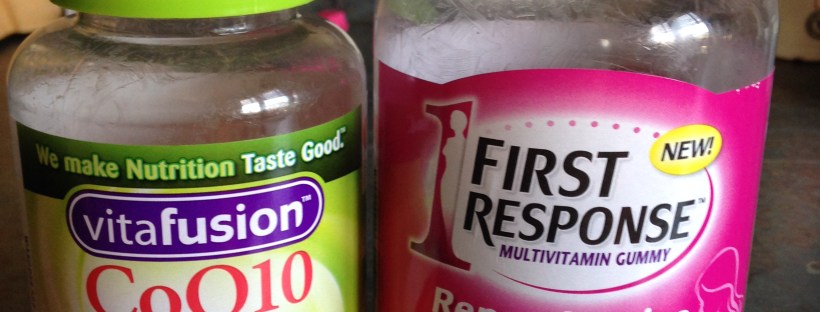
First of all, supplements. I was taking a multi-vitamin gummy that included 400mg of Folic Acid rather than the standard 200mg, which our nurse said was sufficient. But there are other supplements that I could benefit from when trying to conceive other than Folic Acid that supports healthy egg development. Including CoQ10 and Vitamin D, amongst others. So I have purchased these two supplement gummies which provide all the goodies to support good development of eggs (the irony being they are full of sugar…keep reading to understand the irony!!) I chose gummies because my stomach can’t handle the coating of most multi-vitamin pills.

Next, exposure to toxins such as BPA (Bisphenol-A) and phthalates (pronounced THAL-LATES by the way, I had to look that one up ;-)). BPA is in a lot of plastics such as food wrapping, tupperware, water bottles etc. There is a lot on the internet you can read about the bad things about BPA. Among other associated health issues there is evidence to suggest that this toxin can affect egg quality. Worryingly, even ‘BPA free’ plastics may still be toxic.
Pthalates is another toxin that may impact egg quality and has also been linked to miscarriage, this is found in soft plastic, vinyl, cleaning products, nail polish and fragrances. Like BPA, phthalates seems to be everywhere. The CDC has a quick fact sheet on phthalates here.
So how much of this toxic stuff do we have in our household? Well, all our food goes into tupperware. We drink from plastic wrapped and packaged food except on occasion when we buy fancy organic items like juice. To what extent will we be able to avoid BPA? Well it can be quite hard. Here is an article about 6 steps to avoid BPA. I also wear perfume, wash my hair in this stuff and so on and so forth. Here is an excellent article on how to avoid phthalates too. We can start making steps towards this, but it will require some lifestyle changes with tupperware and beauty products!! And this all costs money in the end, quite frankly we are not made of money, so we can try to reduce exposure, but we will not get rid of it completely.
Finally diet. It is no surprise that poor diet is correlated to fertility issues. However, there are some interesting facts in this book that made me think twice. Namely sugar and carbohydrates.
Now, I will admit that I am a bit of a sugar addict. I generally prefer artificial sweetners in my tea and drinks, but I do have a sweet tooth for gummy sweets such as haribo and other desserts. If I had to choose between a starter, main or dessert, I’d always go for the dessert. Having said that, I do eat healthily in general with lots of fruit, veg and healthy main meals. So giving up sugar is going to be difficult. I’m not sure I can go cold turkey on it. For example, having a cup of tea in the morning is my ‘wake up’ tool. I hate tea without sweetner. But I could try to give up eating fresh cookies that I buy every other day at work and give up desserts. Did you know that sugar is even in cornflakes and rice crispies? Chris and I tend to eat granola or other ‘organic’ breakfast cereals, but even these have a lot of sugar in them. Sugary breakfasts will also be hard to give up.
Giving up carbohydrates completely would be bad for you. But giving up simple carbohydrates and replacing them with complex carbs to give a slow release of energy through the day would be a good thing. You have to read the book to understand in detail why this is good for egg development. Chris and I eat healthy dinners in general anyway, so replacing white rice and pasta should be quite easy. However, most brown rice and pasta takes a long time to cook, it will just take longer to prepare dinner.
What’s a girl to do?
To how extreme does one go with this? How much is too much? How far is too far? Is this just another new check list of living a healthy lifestyle? Is everything OK but just in moderation? What is in moderation? Should we just go cold turkey and cut it all out? Should we both do this together? We will never really know the answer to these questions…but Chris and I will keep talking about these things and try to work together to make any changes we see that will benefit us both in the long run.
Now…what am I going to do with this jar of haribo sat in my cupboard??????!!!!!!

mmmmm haribo

The ethics of ICSI – Intra Cytoplasmic Sperm Injection
ICSI for unexplained infertility
I felt pretty well versed and comfortable in the ethical debate behind IVF, well, so I thought until we came across ICSI. Intra-Cytoplasmic Sperm Injection (ICSI) was recommended by our doctor because we have been diagnosed with unexplained infertility. She explained that this procedure is worth trying because in our case of unexplained infertility there could be a chance that there may be something in the fluid surrounding my eggs preventing fertilisation. ICSI overcomes this potential problem by injecting a sperm directly into the egg, avoiding the fluid. It is important to note that with unexplained infertility there could be many other reasons unknown to us why we have not been able to get pregnant yet; we just can’t pinpoint the exact cause at this moment. By performing ICSI (for a few thousand dollars more) it slightly increases our chances of success. I have been looking into the evidence behind unexplained infertility and ICSI and the jury is out on whether it is worth while or not. Despite the mixed reports on the internet, I trust our doctor, and as our fertility clinic is attached to a medical school I like to think that they are up to date on these things.
I hadn’t thought much about ICSI previously because Chris’s sperm is pretty good, I didn’t think it was on the table. So I hadn’t read much about the procedure. As I began to read up on the procedure, I started to think more about the ethics and morality of it. Selecting the ‘best looking sperm’…is it any different to selecting the ‘best looking egg or embryo’ as would be the case for normal IVF? And so I decided to look into it a bit more to understand what ICSI really is, and the considerations for and against this artificial reproductive technology procedure.
This post is just me putting ideas out there and exploring the issues, I do not necessarily agree with everything written here. I may have been unintentionally selective or biased in some of my arguments, there are probably many more arguments for and against ICSI, so please feel free to comment and add at the bottom of my post.
What is ICSI?
ICSI – Intra Cytoplasmic Sperm Injection is an in-vitro fertilisation procedure that has been in use since 1992. Fertilisation is achived by the direct injection of a single sperm into the cytoplasm of the egg. The sperm can be extracted from fresh or frozen ejaculate, as well as being extracted directly from the testes (yikes, sorry guys, doesn’t sound fun at all). The egg is prepared to facilitate penetration of the sperm. The preparation of the egg includes enzymatic treatment and micro dissection of the cells which surround the egg. Injecting the sperm bypasses the normal interaction it would have with the egg upon first encounter. The deliberate selection of sperm for the procedure involves an assessment of selection criteria including: size, form and mobility of the sperm. Despite the selection criteria, there is no guarantee that the sperm is actually ‘normal’ and therefore, there is no guarantee that fertilisation will occur. It is even possible to select X or Y sperm to select gender, but only few fertility clinics offer gender selection for when it is necessary to avoid a known genetic disorder being passed. I have also read about some fertility clinics offering gender selection if the family has one child already, and they want to ‘complete the family’ by selecting the opposite gender of its sibling. This totally blows my mind. After the sperm is injected into the egg, the egg is placed in an incubator and checked the next day for fertilisation. If fertilisation is successful, the embryo is left for 2 or 3 days and then a decision is made whether to transfer the embryos back into the woman’s uterus for the next stage implantation.
Statistically speaking, there is evidence that ICSI slightly increases the pregnancy rate (but not statistically significant) compared to normal IVF. The spontaneous abortion rate with ICSI is slightly lower, but this maybe as a result of the younger age of the mothers and the absence of female-related infertility. The frequency of multiples is about the same (probably because the policies for number of embryos transferred remains the same). The statistics for randomised trials of normal IVF v ICSI show that there is no significant difference. Some researchers suggest that ICSI should only be reserved for the use of severe male factor infertility. However, the use of ICSI is on the rise and becoming the new normal as infertility clinics like to reduce the risk of failure for the patient. I can understand why that little extra % chance all adds up.
Ethical and moral considerations of ICSI – the arguments pro and against.
All ethical debates relating to IVF still apply to ICSI. But ICSI may be considered effectively as a further layer of ethical debate because we are potentially further ‘messing with nature’ by selecting one single sperm. Often Pre-Implantation Genetic Diagnosis (PGD) will be part of ICSI, where there is a screening of cells of pre-implantation embryos for the detection of chromosonal disorders before an embryo transfer. We are not doing PGD. This can also add a further level for debate.
I will start with what I have found regarding the pros of ICSI, and other Artificial Reproductive technologies, followed by the against arguments…
Pro ICSI: The right to procreate. To want a child is probably the most legitimate need in the world. The right to found a family is one of the most important human rights as declared in the Universal Declaration of Human Rights (948, Article 16.1) ICSI enables and supports this right.
Pro ICSI : Genetically related offsping. Before ICSI was possible, couples with male infertility would likely have resorted to donor sperm, or due to religious or personal beliefs would have rejected the use of a donor and remain childless. With ICSI, it is possible for couples to have a child that is genetically related to them that previously was not possible.
Pro ICSI: Reducing the risks to the couple. If natural IVF was chosen over ICSI the woman may be unnecessarily putting herself at increased risk, physically and mentally for both partners. For instance, if natural IVF were to fail first time round, ICSI may have prevented failure. There are no guarantees, but as a couple puts themselves through multiple rounds of IVF, the physical and mental stresses increase, including the financial burden.
Against ICSI: The risks to the child itself. There is much debate about the use of ICSI in male infertility and associated genetic abnormalities. Chris does not have male infertility, so the risk of genetic abnormality is supposedly lower. But the case for natural selection is negated with ICSI, there is no competition as would be with natural fertilisation, the chosen sperm may be a factor in genetic malformation. There is also a risk of choosing a sperm that is immature and may interfere with the process of genetic imprinting and could result in growth retardation and functional disorders. However, there has been little evidence to support these concerns. Having said there is little evidence, ICSI has been around only since 1992, so children born from ICSI have not reached far into their adulthood and so studies are limited on the long term health related issues of ICSI born children. Not to say the least, that the long term generation effects of ICSI on the population overall are not well understood and are only theorised. For example, will infertility be passed? In itself, will ICSI simply contribute to further medicalising in the future?
Against ICSI: Multiple Embryos. With IVF, to give a couple the best chance for a pregnancy multiple embryos are produced, grown, and then implanted into the uterus. Some embryos may be discarded if they aren’t of good enough quality to present a healthy chance of pregnancy. ICSI increases the likelihood for the generation of surplus embryos. For some people, each embryo represents a life and so the disposal of embyros is considered in the same light as abortion.
I found one eloquent and well articulated argument that explains why some people are against multiple embryos “Where doubt exists on the level of fact, the integrity of conscience requires that the presumption be in favour of the life. There is a classic example, if a hunter hears a rustling noise in the bushes, and is unsure whether it is a deer or another human being, he must assume it is a human being until such time as he can establish that it is not. Similarly we may accept the argument that there is scientific uncertainty as to the precise moment when an individual human life begins. That uncertainty, however, does not remove the obligation of care and respect for what certainly has the potential to become, and may already be, a distinct human individual.”
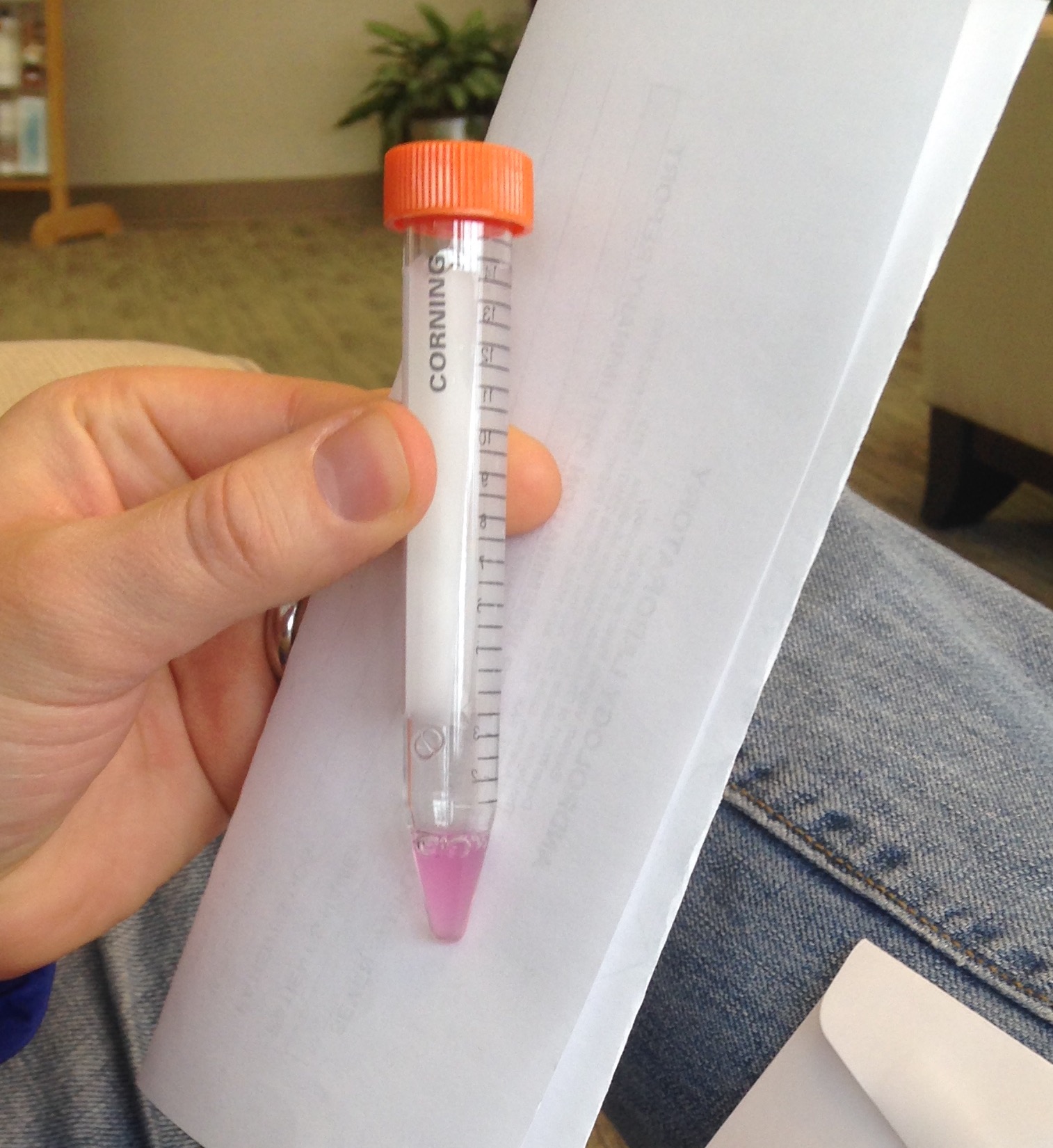
Against ICSI: Human Error. I have read about people worried about sperm/eggs getting mixed up in the laboratories. We learned that sperm is dyed a certain colour for each patient so there is no confusion – this was why Chris’s sperm was purple!! But to err is human after all and so are we potentially increasing the risk for a morally complex problem?
Chris’s purple sperm
Partial ICSI – overcoming some of the issues at hand? Partial ICSI is where some of the eggs are left to fertilise ‘naturally’ in the petri dish as with normal IVF, and the rest of the eggs are injected with individually selected sperm as ‘back up insurance’, just in case normal fertilisation does not occur naturally.
There are many different valid and understandable viewpoints about assisted reproductive technologies like IVF and ICSI. I am the type of person who respects others’ viewpoints and tries to understand as much as possible all sides of an argument. I am an analyst by profession so I like to think I am good at that. We have decided to do IVF and ICSI knowing these issues. I just hope that others can equally respect our decision for IVF and ICSI. But I now feel suitably versed to think about some of the important ethical and moral issues surrounding these artificial reproductive technologies.
Other notes and interesting references
On a side note, I found an interesting statement as I was researching that I wanted to share with you, it is about IVF and women’s rights in general. Mary Anne Warren, (a philosophy professor who wrote a lot about abortion and criteria for personhood) wrote:
“If women’s right to reproductive autonomy means anything, it must mean that we are entitled to take some risks with our physical and psychological health, in the attempt to either have or not have children. Neither abortion nor many forms of contraception are entirely safe, but women sometimes reasonably judge that the alternatives are even less desirable. Having a wanted child can be as important a goal as avoiding an unwanted birth.”
Other references which discuss some of the more interesting medical facts than I am not willing to describe in my blog as I am not a medical professional or just interesting…
Potential Health Risks Associated to ICSI: Insights from Animal Models and Strategies for a safe procedure, Front Public Health. 2014. 2: 241. Accessible here: http://www.ncbi.nlm.nih.gov/pmc/articles/PMC4235077/
Ethics of Intracytoplasmic Sperm Injection: proceed with care, Wert, G.M., Human reproduction, 1998 vol 13 (1) Accessible here: http://humrep.oxfordjournals.org/content/13/suppl_1/219.full.pdf
Dealing with uncertainties: ethics of prenatal diagnosis and preimplantation genetic diagnosis to prevent mitochondrial disorders, Human reproduction update, 2008, vol 14 (1), Accessible here: http://humupd.oxfordjournals.org/content/14/1/83.short
Ethical issues in Assisted Reproductive Technologies, a presentation by Effy Vayena: http://www.gfmer.ch/PGC_RH_2005/pdf/Ethics_IVF.pdf
Ethical issues arising from the use of Assisted Reproductive Technologies, Dickens, B.M., Accessible here: http://citeseerx.ist.psu.edu/viewdoc/download?doi=10.1.1.195.8966&rep=rep1&type=pdf

Suggestions for keeping your sanity on the Emotional Roller Coaster of Infertility Treatment
In our pack of homework there was a little article from our fertility clinic’s resident psychologist. I am sure she wouldn’t mind me copying it to my blog to share with everyone else if it helps anyone else. Thank you Dr Barbara Kersey for your wise words….
1. Lower your expectations of yourself at this time. Infertility treatment is stressful. Learn to say “no” to other commitments that are not absolutely necessary. Chris and I both agreed we need to do this more.
2. Don’t listen to “horror stories” from other patients or friends. Keep your own counsel in the waiting room. Exchange only helpful, positive suggestions with others. I haven’t heard too many horror stories on the blogs. I don’t go to forums too much because this is where I have come across horror stories. I’ll be honest, I tend to find bloggers a bit more educated in their opinions compared to those who may be posting on forums. That doesn’t mean all people on forums are not educated, I just find that sometimes forums can be a little laisez faire behind posts. So far we have not spoken to anyone in the waiting room, and we probably won’t; it’s quite a daunting place, but you never know if someone there has just had a miscarriage or just found out they are pregnant. I’m not inclined to start any conversations here.
3. Make it your business to be as calm as possible when you are here for treatment. This won’t guarantee that you will get pregnant, but it can only help. Whenever I have an appointment I have had my blood pressure taken – there is definitely a correlation behind the type of appointment and my increased blood pressure! But I have noticed that it was lower for my third IUI. Hopefully that is because I am relaxing a bit more.
4. To help develop your sense of calm, try yoga, meditation, full body massage, journaling, walking etc. ANYTHING that helps keep your balance. I love yoga, blogging, walking – I think one can always add in a massage or two here or there!
5. Recogonise that the staff is here to help you. Anxiety and anger are natural feelings, but won’t help you (or anyone else) to let staff bet the recipient of these feelings. We spoke with a nurse once about this issue. I said that they must have a very difficult job when dealing with such sensitive patients. The nurse said she finds it hard and there are very difficult days, but equally a number of rewarding days. She never knows how a patient will react so tends to keep very reserved. My hats go off to the doctors and nurses working in this industry for the challenges they face everyday.
6. Get outside support. Try Resolve, the national support group for couples who deal with infertility. For information go to www.resolve.org. Once softball league is finished next week, we might go to one of our local meetings. We both agree it might be a good idea to meet some others and get some support.
7. Recognise that infertility is a COUPLES’ issue. Keep the lines of communication open with your partner. Infertility is a huge stress on marriage. Get outside help if needed. Well Chris wrote a blog post about this the other day…so I won’t say much more other than he is a great rock to me, I hope I am to him too. I hope we can keep doing this all the way until we have a little F. (Obviously keeping the whole marriage thing up afterwards too 😉 )
Happy Friday Y’all!!! (Check me out with my American speak!!!)

First meeting with our IVF Nurse Coordinator
On Tuesday Chris and I met with our IVF Nurse Coordinator at the fertility clinic. She had asked us to set aside about 1.5hrs for the session, so we both took the afternoon off work…and I’m glad we did! I left the meeting with that type of headache feeling you get after you have just sat a 2 hour exam. I felt completely awash with new information. Fortunately, we were given a nice homework pack to take home and read so we could absorb it in slow time.
We discussed the IVF process, basic biology and advanced cell biology. Schedule and timings of events. Medication and blood tests for both of us. We also talked about insurance issues, consent forms, checklists and calendars. Our nurse has been doing her job for 15 years, she knows everything there is to know. I was seriously impressed.
Unfortunately the embryology lab is closed for a few weeks in June/July. We thought this would be OK, but when we actually sat down with my period dates we worked out that we were going to have to wait another month. The nurse is not allowed to start anyone on a cycle that starts from the 29th May to 20th June. As my period started yesterday my next period is due around the 16th June. We were hoping I would two 28 day cycles to push me to the 20th June, but it now looks like that won’t happen. I was very frustrated. This means we will be expecting a retrieval date around either 3rd or 10th August, right in the middle of my mum visiting us in the US. Which I am sure she won’t mind, but it means we can’t plan any fun sight seeing trips until we get closer to the date. At least we will have time to get medications sorted and August is a nice quiet time at work so that will be good but Grrrrr, July would have been so much better for us. Oh well.
It looks like our insurance will cover Intracytoplasmic Sperm Injection (ICSI). Great news! We now need to sort out purchasing our long list of medication (by all means, I have a very short list compared to some other ladies) and choosing a pharmacy that our insurance accepts (we discovered we can choose what ever pharmacy we want and what ever brand of medication we want too).
My list of medication will be:
Birth Control Pills – yup, it’s ironic! I’ve never taken these before so I had a lesson on how to take them! This will help controlling my cycle so we can start the IVF stimulation at a certain time.
Gonal-F or Follistim – this is a Follicle Stimulation Hormone drug, adminstered by a subcutaneous injection. Oh great! Needles! This helps stimulate the ovaries to grow lots of follicles, more than I did for the IUI where I had 2-3 follicles, the goal is 20 or so! Yikes.
Menopur – A Follicle Stimulation Hormone together with a Luteinising hormone (were you paying attention in GCSE biology??!). Another subcutaneous injection.
Ovidrel – The trigger shot. Been there, done that. Although this time I will be taking this injection at a very precise time just before my egg retrieval surgery.
Ganirelix or Cetrotide – this will prevent me from ovulating on my own so the eggs are ready at the right moment for retrieval. Another subcutaneous injection. Wow. Four different needles already.
Progesterone in oil – I’ve heard about this one before and the needle terrifies me! It is an intramuscular injection. Just google progesterone in oil and look at the images page. This is instead of the progesterone suppositories I had with the IUI. Chris will have to give me this injection every night – in the buttock muscle! Have you seen the size of that needle????!?!?!
Vivelle patches (transdermal etrogen) – An estrogen hormone patch. YEY something that isn’t an injection!!!
Doxycycline – antibiotic for my egg retrieval (so I don’t get an infection after inserting the big needle they are getting to use to retrieve my eggs through my vaginal wall) Chris also gets to take doxycyline because we are doing ICSI, this drug affects the sperm and makes them less ‘sticky’ so it’s easier for them to select just one sperm to inject into my egg for fertilisation. That was something I did not know! Rather cool.
It was an intense session, but I was very excited that we are actually starting this and moving a step closer to becoming pregnant. We came home in a bit of a daze afterwards. The emotions running around were definitely mixed. Interesting times ahead.
 The Great Pudding Club Hunt